For more than four decades, lighting director and designer Steve Baird has helped shape the visual identity of some of the world’s most respected touring artists. His career spans work with Dream Theater, Steely Dan, Norah Jones, and Julio Iglesias – each with distinct creative demands. But through decades of technological change and increasingly complex productions, one constant has remained: his reliance on WYSIWYG.
“I’ve been using WYSIWYG since version 1.2 in 1995,” Baird says. “It’s been with me my entire career. It’s my sidekick.”
A 30-Year Creative Partnership with Dream Theater
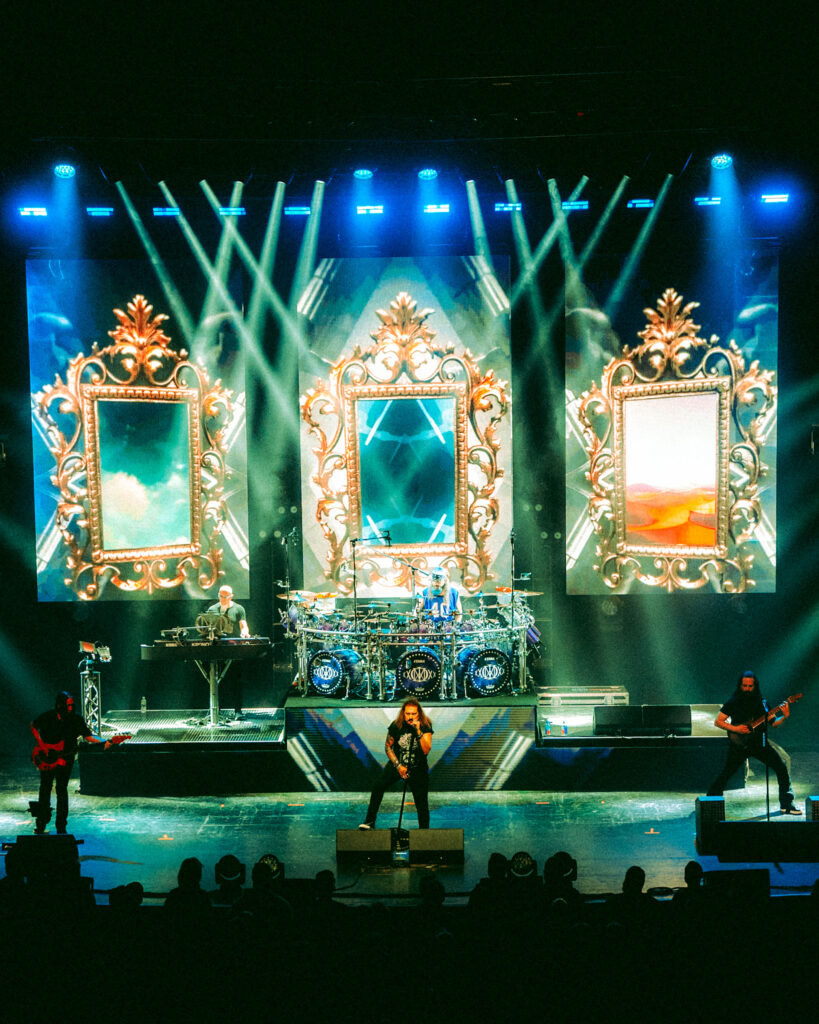
Baird’s relationship with Dream Theater began in 1995, when he stepped in mid-tour. What began as a temporary role evolved into a creative partnership that has now lasted more than 30 years.
Most recently, he has been designing and directing lighting for the band’s 40th Anniversary Tour, built around their latest album, Parasomnia. The tour has already exceeded 100 shows across North America, Europe, and South America, with Asia and additional international dates underway.
Dream Theater’s music presents a unique creative challenge. Known for its technical complexity and extended compositions, their performances demand lighting that is both precise and expressive.
“Their music is incredibly detailed and dynamic,” Baird explains. “You’re not just lighting songs – you’re supporting movements within songs. The lighting has to evolve constantly.”
Performing in venues ranging from theaters to 14,000-seat arenas, the production must adapt seamlessly to different scales while maintaining creative consistency.
Designing for the Reality of Global Touring
One of the biggest challenges in modern touring is variability. Every venue is different. Fixture types, rigging configurations, and system availability can change daily – especially during international runs.
This is where WYSIWYG becomes essential.
Baird uses the software to pre-visualize entire lighting rigs, program cues, and adapt designs to each venue long before arriving onsite. Working from his home studio – what he calls his
“WYSIWYG suite” – he builds and refines shows using multiple monitors and his lighting console.
“I can patch fixtures, program looks, render scenes, and see exactly how everything will work,” he says. “By the time I arrive at the venue, most of the creative work is already done.”
This preparation dramatically reduces onsite programming time and ensures consistency across the tour. When fixture lists change – as they often do – WYSIWYG allows him to quickly rebuild and adapt the show. “I need to see the lights working before I walk into the venue,” he explains. “Visualization gives me that confidence.”
Festivals present another layer of complexity, with limited programming time and shared systems. With WYSIWYG connected to his lighting console, Baird can build and refine shows independently, without relying on venue access. “I can sit down anywhere – backstage, in a corner, even in a hotel room – and continue working,” he says. “It gives me complete freedom.” This flexibility ensures that every performance meets the same creative standard, regardless of the circumstances.
Realism That Drives Creative Decisions
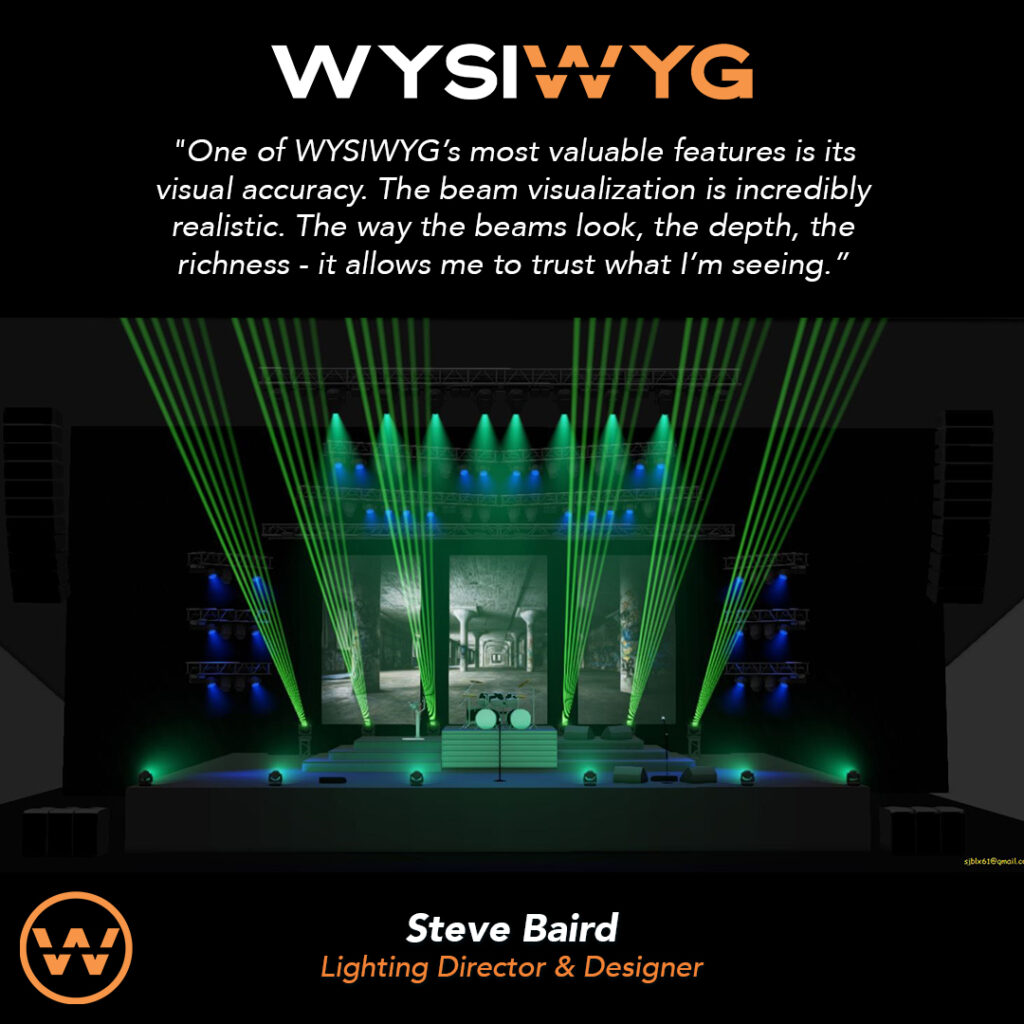
For Baird, one of WYSIWYG’s most valuable features is its visual accuracy. “The beam visualization is incredibly realistic,” he says. “The way the beams look, the depth, the richness – it allows me to trust what I’m seeing.” That realism allows him to make creative decisions earlier, refine ideas faster, and communicate clearly with artists and production teams.
Equally important is the platform’s integration. “Everything is in one place. I can design, patch, program, and render without switching between different programs. That’s huge.”
Throughout his career, Baird has adapted his lighting approach to suit each artist’s identity.
With Dream Theater, the focus is precision and dramatic intensity. With Steely Dan, the lighting supports a large ensemble of musicians with subtlety and musical sensitivity. With Norah Jones, the emphasis shifts toward atmosphere and emotional tone.
Despite these differences, WYSIWYG remains central to his process. “It doesn’t matter the artist or the scale,” he says. “WYSIWYG gives me the tools to design with confidence.”
Still Creating, Still Touring
After more than 40 years in the industry, Baird remains as passionate as ever. He continues to tour globally, designing lighting for major productions and pushing his craft forward.
“This career has allowed me to travel the world, work with incredible artists, and support my family doing something I love,” he says. And through it all, WYSIWYG remains a constant partner – enabling creativity, adaptability, and precision at every stage. “It’s been with me since the beginning,” Baird says. “And I still rely on it every single day.”