
For more than two decades, lighting designer James Simpson has worked at the intersection of theatre and technology. Long before real-time tracking and virtual production became industry buzzwords, Simpson was already building his career around digital visualization tools – most notably those developed by CAST Software.
What began as student experimentation evolved into a defining through-line of his professional life: a belief that precision, reliability, and spatial intelligence are the foundations of great lighting design.
The Early Years
Simpson first encountered WYSIWYG as a student at 19. At the time, visualization was still emerging as a practical design tool. For many, it was about producing convincing renders. For Simpson, it was about something more critical: dependable information.
When he began working at an opera house early in his career, visualization quickly became central to planning productions. Over the next decade, he helped refine workflows that integrated lighting, scenic, and video design into unified digital environments. Major West End productions followed, including Harry Potter and the Cursed Child and Miss Saigon, where previsualization was no longer optional but essential.
Through every phase of his career, WYSIWYG remained constant.
While other platforms occasionally offered more visually polished output, Simpson consistently returned to WYSIWYG for its depth of technical data. Instant access to accurate measurements, fixture specifications, and spatial relationships meant fewer assumptions and fewer errors. In high-pressure theatrical environments, that reliability translated directly into creative freedom.
For Simpson, the lesson was clear: the best tool is not necessarily the one that looks the most impressive – it’s the one that allows the designer to work with total confidence.
Founding Copper Candle
By 2017, the industry was shifting again. Game engines were becoming mainstream. Motion capture systems were more accessible. Real-time rendering was redefining production pipelines.
Recognizing the opportunity, Simpson founded Copper Candle – a company designed to bridge live events and emerging digital technologies. The studio supports clients with digital integration, augmented reality, visualization, and interactive production workflows. It also produces virtual live performances inside platforms like Fortnite, combining motion capture and real-time environments to create entirely new audience experiences.
At the core of this work is spatial computing: the ability to understand where performers and objects exist in real space and use that data to drive lighting, video, automation, and digital systems seamlessly.
It was a natural progression from the visualization work that had defined the first half of Simpson’s career.
A Practical Test: Sweeney Todd
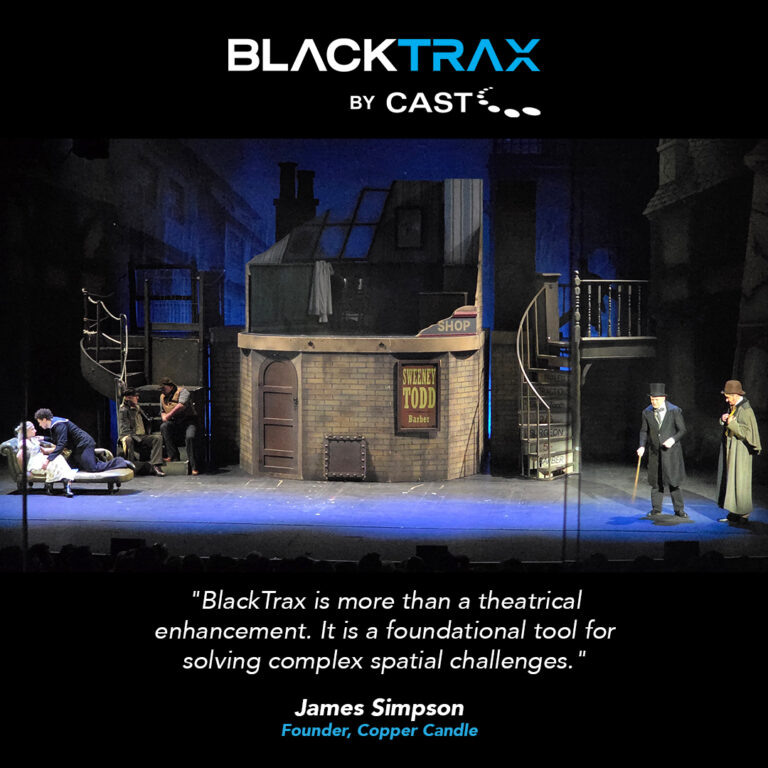
Simpson’s recent deployment of BlackTrax on a production of Sweeney Todd at London’s Churchill Theatre marked a pivotal moment and a perfect testing ground.
Working with a small team, he installed a nine-camera tracking system and integrated it with WYSIWYG to create a fully responsive lighting environment. Tracking markers were discreetly sewn into performers’ costumes. In one particularly ambitious experiment, markers were placed along a performer’s arm and wrist to allow the system to follow the character’s raised razor prop with pinpoint precision.
During calibration, the system’s potential became undeniable. As the calibration wand was lowered from head height to the floor, 40 moving lights converged flawlessly onto a single point. The precision was exact and repeatable.
Designing with Confidence
With BlackTrax handling real-time positional data, Simpson reimagined the lighting design. Rather than washing the stage in general illumination, he created a stark, atmospheric environment inspired by hazy Victorian London. The set remained intentionally dark, with performers illuminated precisely and dynamically as they moved.
Beam sizes adjusted automatically as actors approached or retreated from fixtures. Lights faded seamlessly when performers exited tracking zones. Subtle backlighting followed movement across the stage without the visible sweep of traditional follow spots.
In one striking effect, the tracked razor glinted under precisely controlled illumination, something nearly impossible to achieve manually.
What stood out most was not just the creative flexibility but the stability. Once configured, the system ran reliably. Simpson could step back and observe rather than constantly intervene. Even during long technical rehearsals, the tracking held steady.
For an industry accustomed to tight timelines and high stakes, that level of dependability is transformative.
The Bigger Picture: Spatial Intelligence as Infrastructure
For Copper Candle, BlackTrax is more than a theatrical enhancement. It is a foundational tool for solving complex spatial challenges.
Clients frequently approach the company with ambitious concepts but no clear technical pathway. Whether integrating lighting with video, synchronizing automation systems, or creating interactive environments, many solutions hinge on understanding spatial relationships in real time.
BlackTrax provides that intelligence.
Instead of building bespoke tracking systems from scratch – an expensive and risky undertaking – Copper Candle can deploy an established platform capable of mapping performers and objects accurately within a three-dimensional environment. That spatial awareness unlocks new creative possibilities while reducing technical uncertainty.
A Continuing Evolution
Looking back, Simpson’s career forms a clear arc – from early visualization experiments to fully integrated spatial computing systems. The thread connecting each phase is a commitment to tools that enable precision.
His renewed collaboration with CAST reflects that continuity. From WYSIWYG to BlackTrax, the company’s technologies have provided the backbone for his most technically ambitious work.
As live performance continues to merge with digital production, that backbone becomes even more critical.
For Simpson, the future of lighting design is not about spectacle alone. It is about intelligent systems that empower designers to focus on storytelling – confident that the technology will deliver exactly what it promises.
And in that evolving landscape, precision remains everything.